

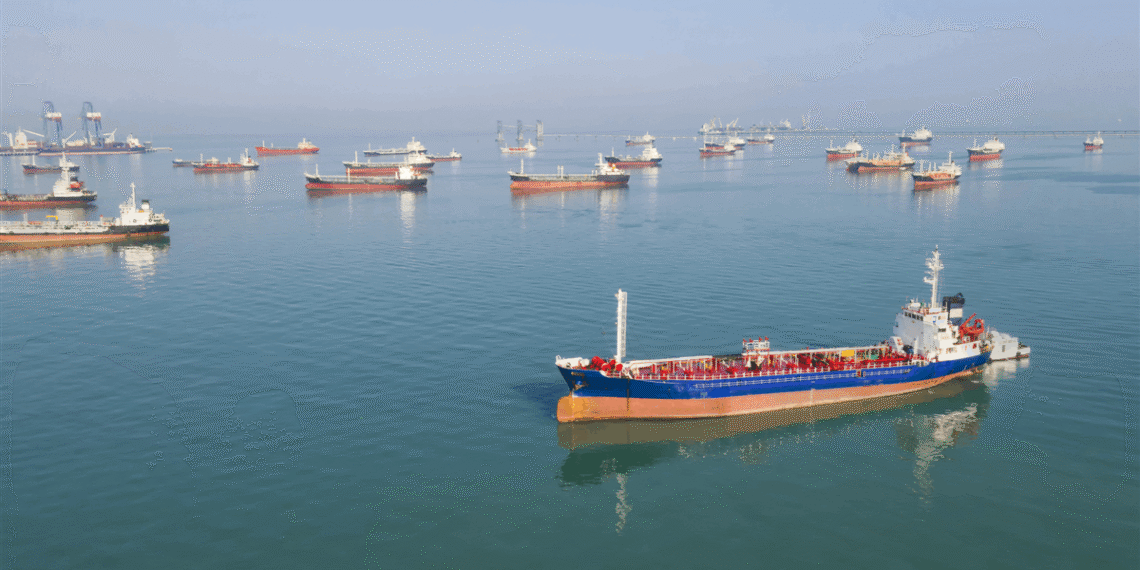
The United States has issued a temporary waiver allowing countries to purchase certain Russian oil supplies currently stranded at sea in a move aimed at easing soaring global oil prices.
This was disclosed by U.S. Treasury Secretary Scott Bessent in a statement posted in the early hours of Friday, March 13, 2026, on his X account.
The waiver applies specifically to Russian-origin oil shipments that are already in transit across global waters but unable to reach buyers due to existing sanctions and geopolitical disruptions.
Bessent said the measure was designed to temporarily expand available supply in the global market while limiting any financial gain for Moscow.
- “To increase the global reach of existing supply, U.S. Treasury Department is providing a temporary authorization to permit countries to purchase Russian oil currently stranded at sea,” he said.
According to him, the authorization is narrowly structured and only applies to oil that is already moving through international waters.
- He added that the measure “applies only to oil already in transit” and would not significantly benefit the Russian government, noting that it “will not provide significant financial benefit to the Russian government, which derives the majority of its energy revenue from taxes assessed at the point of extraction.”
Bessent also said the recent spike in oil prices was temporary and would eventually benefit the U.S. economy in the long run.
- “President Trump’s pro-energy policies have driven U.S. oil and gas production to record levels, contributing to lower fuel prices for hardworking Americans,” he said, adding that the temporary increase in oil prices represents “a short-term and temporary disruption that will result in a massive benefit to our nation and economy in the long-term.”
Backstory
In March 2022, less than a month after Russia invaded Ukraine, then U.S. President Joe Biden announced a ban on Russian oil and other energy imports.
- At the time, the United Kingdom also pledged to phase out imports of Russian oil and petroleum products before the end of the year as Western nations moved to isolate Moscow economically.
- However, the latest crisis in the Middle East — triggered by escalating confrontation between Iran and the combined forces of Israel and the United States — has forced global leaders to once again look to Russian supplies to stabilize energy markets.
Earlier, the U.S. issued a 30-day waiver on March 5 specifically for India, allowing New Delhi to purchase Russian oil that had been stranded at sea.
The broader waiver for other countries comes days after Russian President Vladimir Putin held a call with Donald Trump and presented proposals aimed at achieving a quick settlement to the war, according to a Kremlin aide, a development that eased some concerns about global oil supply.
More insights
The ongoing conflicts have triggered significant volatility in the global energy market, with ripple effects being felt across several economies, including Nigeria, where refiners and fuel distributors have begun adjusting petrol prices.
- Oil surged to more than $119 per barrel on Monday — its highest level since mid-2022 — amid supply cuts by Saudi Arabia and other producers that heightened fears of major disruptions to global supplies.
- Although prices briefly dropped to about $91 per barrel the following day, the market rebounded quickly. As of Friday morning, Brent crude futures were trading at $99.85 per barrel, while West Texas Intermediate crude stood at $95.05 per barrel.
Two days ago, the International Energy Agency also announced plans to release 400 million barrels of oil from strategic reserves to help ease the global supply shortage.
What you should know
According to the International Energy Agency, Russia’s crude oil exports declined by 410,000 barrels per day in February compared to January, falling to about 4.2 million barrels per day.
- Reuters also reported that Russia’s oil and fuel export revenues dropped by $1.5 billion month-on-month to $9.5 billion — the lowest level recorded since 2022.
- Before the war, Russia was estimated to pump between 7 million and 8 million barrels of crude oil and fuel per day into global markets, representing roughly 7% of total global supply.
However, the new conflict engulfing Gulf nations and parts of the Middle East has disrupted one of the world’s most critical oil shipping routes — the Strait of Hormuz — creating fresh opportunities for Russia to expand its oil sales.
Reports indicate that about 124 million barrels of Russian-origin oil were stranded on water across 30 different locations globally as of Thursday, awaiting buyers or regulatory clearance.